- Հայ
- Рус
- Eng
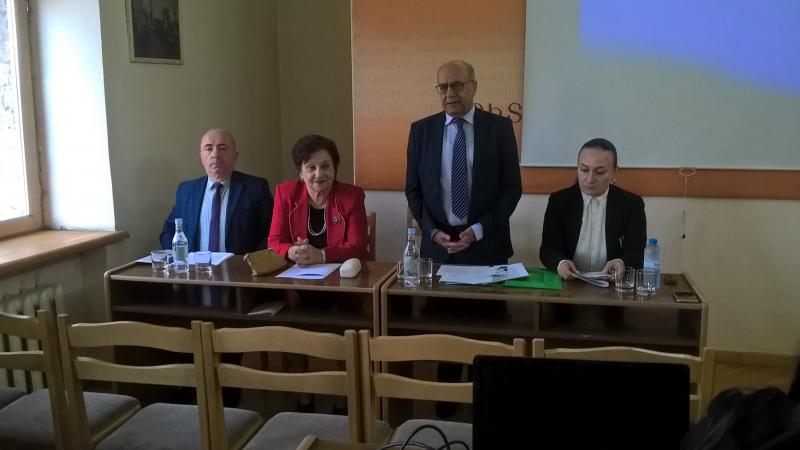
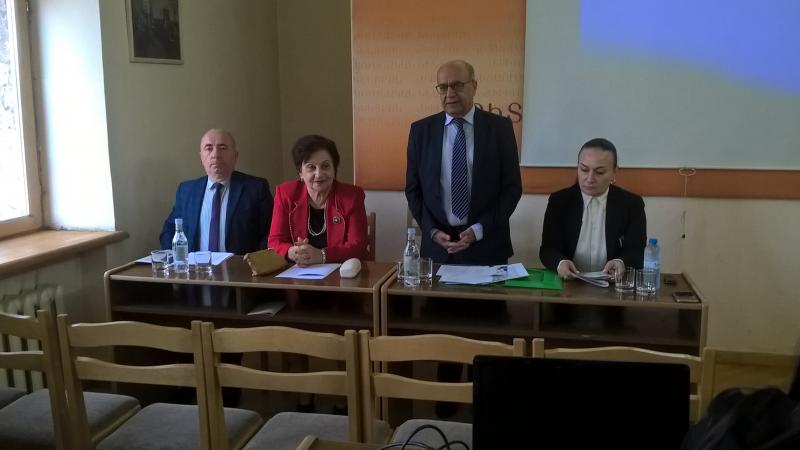
Scientific Session headed “Armenian-French Literary-Historical Relations” was organized by the initiative of the Pedagogical University Chair of Contemporary and New Armenian Literature and its Teaching Methods after V. Partizouni.
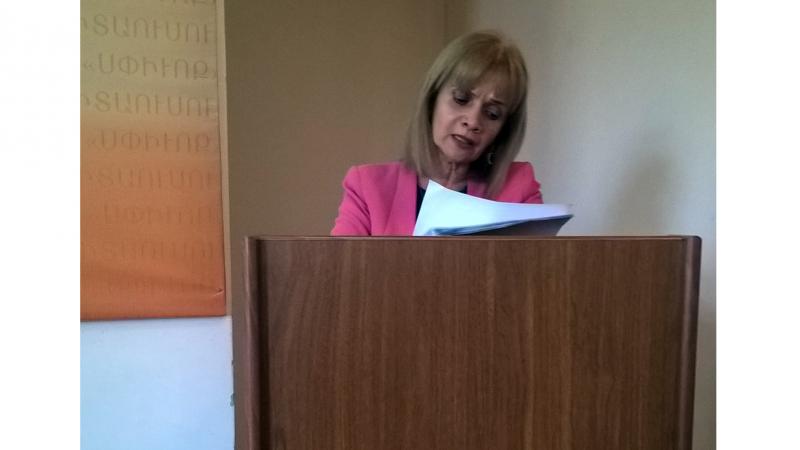
The ASPU Vice-Rector for Academic Affairs Srbouhi Gevorgyan welcomed the participants of the scientific session and spoke about the Armenian-French relations, Armenian individuals who played decisive roles in various areas of those relations. She emphasized that in the 19th-20th centuries not only French people had a significant role in Armenian-French relations, but also Armenians living in France, among whom one could distinguish Charles Aznavour and the heritage he left in cultures of both countries.
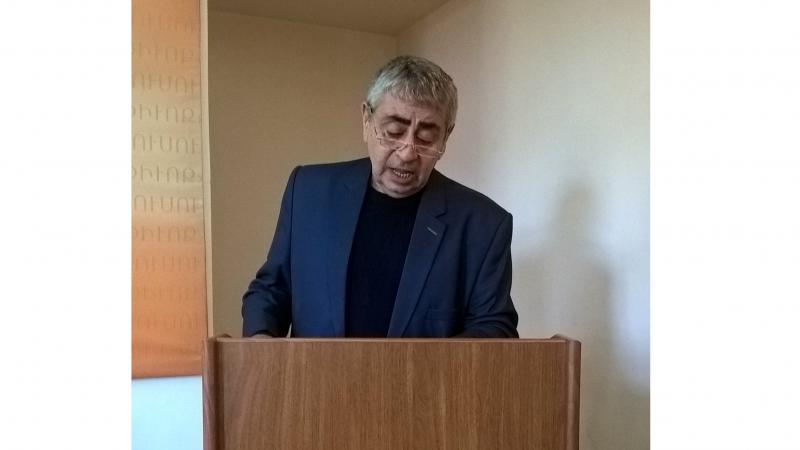
In his report the Head of the Chair of Contemporary and New Armenian Literature and its Teaching Methods after V. Partizouni, Professor Suren Danielyan referred to certain episodes of typological commonality between the characters created by Nar-Dos and Henri Troyat.
He was sorry to notice that “even today, in Armenian literary world it is uneasy to mention the name of Henri Troyat – the poet who recorded exceptional accomplishments in French prose in the 20th century”. Besides, the Professor also said and particularly outlined that “even Nar-Dos was not in the best situation, who had in the recent years been pulled out of the list of authors in the programme”; as well as, he spoke about “submitting the claim for return of the Pan-Armenian cultural dignity” referring to the common unique entreaties.
In H. Troyat’s works from the “Spider” to the extensive novel “Anne Predaille” his characters were standing out for their “identical drama”.
“You may change the names, but the country is the same, and human beings are more dominant. Spiders are everywhere”, wrote H. Troyat. According to him the mundane, even the grey every-day routine was much brighter that the thought of subjection. The delicate cognitive features of the “Spider” structures prompted how Troyat was knocking the doors of naturalists’ camp with hesitation”, mentioned Professor S. Danielyan with the following conclusion; “the sharp criticism of discretionary philosophy exists in the novel “Spider”, which was actually given a broad and artistic explanation to by Nar-Dos.” And these two writers in their works touched one of the noted issues of the world literature of the 20th century, the “boredom of existence”.
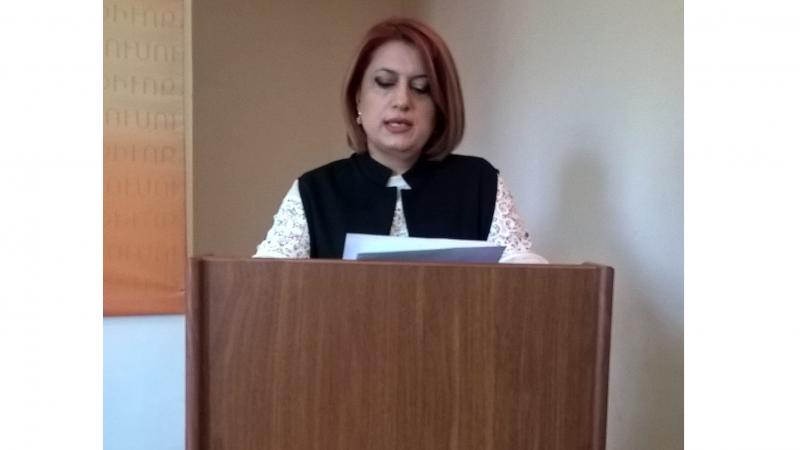
The Associate Member of the RA NAS Professor Aelita Doloukhanyan presented her report about “Jean-Pierre Mahé as a translator of Koryun’s “The Life of Mashtots”.
The Professor thoroughly referred to the scientific debates on the creation of a tri-lingual alphabet by Mashtots, emphasised that the first translation of Koryun’s “The Life of Mashtots” was made by Mkrtich Emin by the assignment of Victor Langloi, as well as stated that “Jean-Pierre Mahé’s translation was much more beneficial first of all for the fact that it presented the broadened version of the Life compiled by Manuk Abeghyan’s and that made it specifically important and different from other translations available in Paris in 1969”.
By recalling historians, literary critics, and Armenologists of different times, the reporter outlined N. Marr, who “stated about the Armenian literary and cultural influence on Georgian literature and culture from the V to VII centuries, which also included the theory of the origin of the Georgian alphabet from Mashtots and the translation of the Bible from Armenian”.
What is more, the Historian Movses Kaghankatvatsi writes in his work “History of Aghuank” that “…one of the former educators, inspired by the Holy Spirit, created an alphabet for three nations- Armenians, Aghuans and Georgians”, even though today’s Azeri people consider the creation of Alphabet by M. Mashtots offensive.
Referring to the pros and cons’ hypothesis about the creation of an alphabet for three nations by Mashtots, A. Doloukhanyan defended the fact that Mashtots strived for establishing peace by creating alphabets for the three nations in the Caucasus.
“These details outline the importance of the gratifying work that was skilfully implemented by an exceptional specialist of studies of Narekatsi and Armenologist Jean-Pierre Mahé ,by translating the complete original work by Koryun “The Life of Mashtots” into French and skilfully annotating each page therein,” concluded the reporter.
The topic of the report by the Candidate of Philology, Associate Professor Ashot Galstyan was about the artistic-documentary bases of the journal by Emilie Carlier “Au Milieu des Massacres”[Among the Massacres].
By making a historical reference, he explained that “the memoires were a reminding record of events and faces of the past, which had a specific genre first of all in terms of the written speech, and that the roots of the memoirs went back to the depth of centuries.”
From this perspective he presented a remarkable journal compiled by the wife of the French Council in Armenia Emilie Carlier “Au Milieu des Massacres” [Among the Massacres]. It consisted of both historical facts and real happenings, through which the author revealed the closed pages of the past.
The events presented in the journal referred to the horrible massacres committed from 1894 to 1895, which the Council couple witnessed.
The reporter thoroughly presented this work, which was considered as “One of the Jewels of French Memoir Literature”; he outlined the rich vocabulary used by the author, the imagery thinking and the ease of narration, the dialogues in the dairy distinguished by various tone combinations.”
Further on, the report presented by the RA NAS Director of the Literature Institute after M.Abeghyan Vardan Devrikyan referred to the Armenian traveller’s journal about the Armenian-French relation in the 17th -18th centuries.
The report of the Professor Martin Gilavyan on “French Symbolism and Development Directions of Western –Armenian Poetry” was a comprehensive narrative about the Western –Armenian literary developments bred by the French literary sources, literature created in the context of their common features.
The reporter disclosed the influence of symbolism, one of the interesting and complicated phenomena in the end of the 19th and the beginning of the 20th centuries –, which is one of the most wide-spread literary flows, not only in literature, but also in diverse areas of culture, presenting the forms of literary manifestation in works of Metsarents, Siamanto and others.
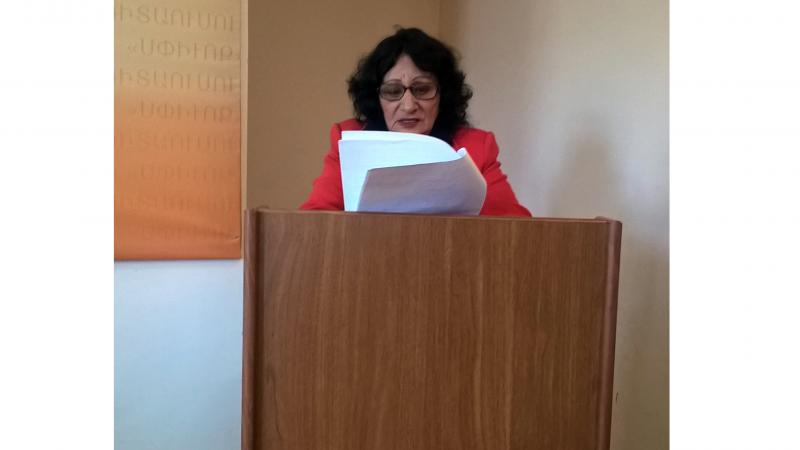
Afterwards, in her report on the “Armenian Trajectory of the Collection by Iskuhi Minas “Divine Illusion”” the Lecturer of Foreign Languages, the employee of the French Embassy in Armenia Nvard Vardanyan introduced the story of life and creative path of Iskuhi Minas, who had been cast away from her homeland by fate. Iskuhi Minas is the author of more than ten prose and verse pieces,; however she is not very well known among the Armenian readers. She knew French, Italian, Latin languages, composed and made translations. In her collection “Divine Illusion” which was, in fact, translated by Nvard Vardanyan, the author opened the world of human emotions to readers. N. Vardanyan assured that I.Minas’ French was flawless and her speech was rich.
Next in turn, Professor Albert Makaryan presented his report on “The French “Polichinelle” and Hagop Baronian’s “National Bigshots”, where he described the contextual essence of the “Polichinelle”, the satirical mirror of French reality, drawing parallels with the satirical paper by Hagop Baronian. The humped character of the “Polichinelle” with a massive nose appearing in the French satirical paper, which in fact, exists up till now, was presenting all that was considered a secret and what everybody was silent about, whereas, H. Baronian was disclosing a bit broader layers by mocking the serious and not very serious happenings in the Armenian reality.
The reporter was assured that by all means the “Polichinelle” had its influence on H.Baronian’s satirical paper; on the one hand the French hero is impartially mocking, on the other hand H.Baronian is ruthlessly presenting the real and unreal images through the art of theatre.
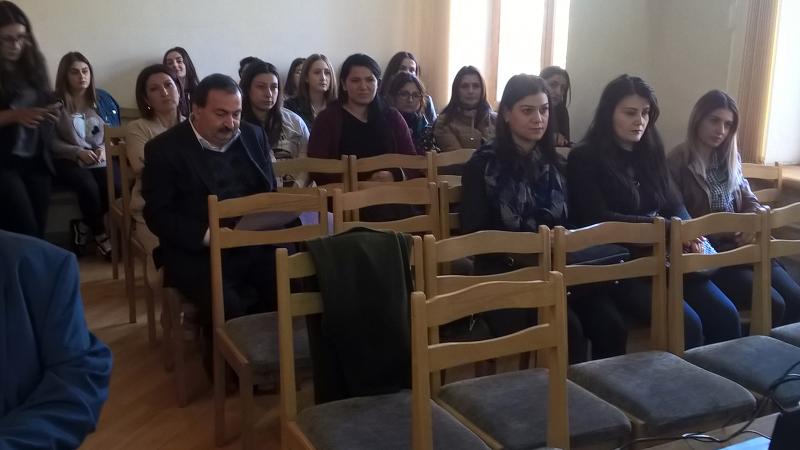
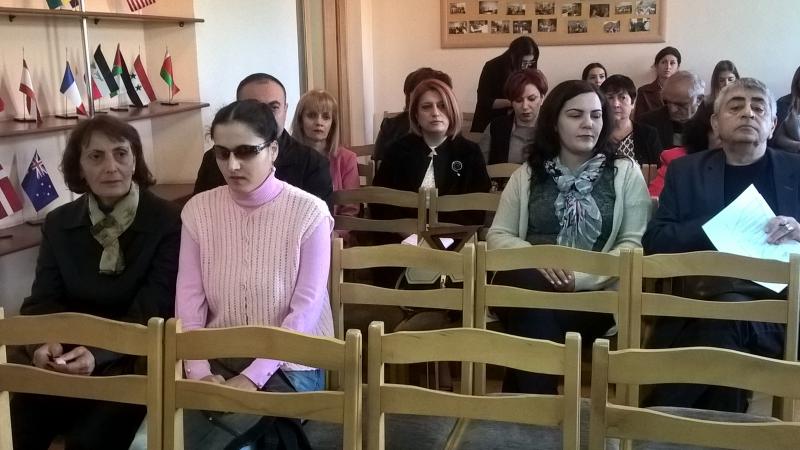
The agenda of the event consisted of 15 reports, each of them interesting and presenting Armenian-French relations. Candidate of Philology, Associate Professor Lucinei Galstyan presented her report on the novel by Vahé Qacha “The Party of Predators”, Armenouhi Muradyan presented “French Poetry Business Card by Abraham Alickyan”, Qnarik Abrahamyan presented the “Lamartine in the Armenian Literary Centres of the 19th Century; a few highlights”; similarly, the third and fourth year students of the Faculty of Philology also delivered their outstanding reports.
This scientific session was an immense tribute to the Francophonie Days in Armenia within the context of Armenian-French ancient and day-by-day strengthening literary and cultural interactions.