- Հայ
- Рус
- Eng
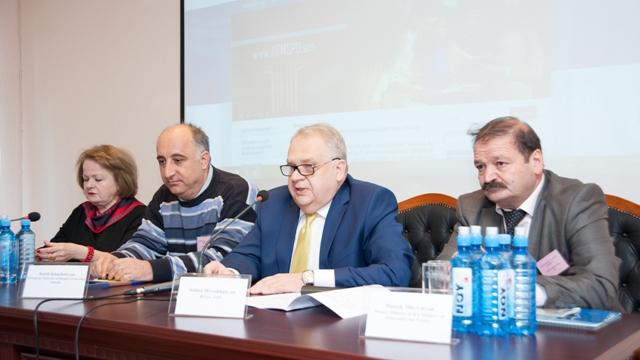
“An important and responsible process is under way at Armenian State Pedagogical University these days. New approaches and new education technology are introduced to the learning process, which aim to organize the learning process in such a way as to help students bring out their qualities and achieve results on their own, and develop their ability to think clearly and rationally during the process,” ASPU Rector Ruben Mirzakhanyan said during the opening of a two-day conference entitled “Measurement, Assessment, and Evaluation of Education Quality” which was organized by the Department of Professional Education and Applied Pedagogy.
Speaking about the problem of measurement and assessment of the quality of higher education, the rector emphasized that they need to develop an approach which will allow assessing independent thoughts and will encourage and reflect independent thinking of students. “During the learning process we should teach them and in the end we should assess that very process,” the rector said. He expressed hope that the approaches heard during the conference will be effective and will be used by the participants in practice.
Deputy Minister of Education and Science of Armenia, Manuk Mkrtchyan, also expressed his observations and concerns about the conference theme. He noted that measurement and assesment of education quality can be done with the theses of conference participants. “It is a knowledge-based system and it gives a certificate of general education but this does not only apply knowledge. Assessment should have its meaning and significance,” he said.
The deputy minister also spoke about differences in assessment systems applied during school-leaving and university entrance examinations. Mr Mkrtchyan concluded his speech with the belief that they can think about introduction of new assessment technologies but they should clearly understand that learning technologies must be combined with the assessment system.
International education expert, Professor Bill Boyle first introduced himself and the years of close cooperation with Armenia, then spoke about mechanisms of teacher evaluation and issues of measurement, assessment and evaluation of education.
When did I complete my university education? What do I understand by saying ‘learning’ and ‘assessment?’ Is there any connection between them? The expert proposed the conference participants to contemplate over these issues during the two-day event and then discuss the quality of education and assessment criteria.
Bill Boyle also advised everyone to be open to new ideas, opinions and observations irrespective of their achievements and scientific titles as ‘everything is zeroed out if there is not a humanistic approach.’
“Do teachers realize that education is a process of adaptation?” He says the answer to this question will allow verifying whether the assessment has been done or not.
Lilia Balasanyan, Chairperson of the Armenian Association of Russian Language and Literature Teachers, conveyed the greetings of Svetlana Bondareva, Rector of Moscow Psychology-Social Institute, and wished that the Pedagogical University continue to keep schools in the centre of attention, preparing experienced specialists who will organize high-level professional training courses. “We already have good educators, our teachers only need to use best practices of this or that country.”
“Many of us studied in the old and good Soviet school. As time passed by, a competition emerged in the education sector and quality education became imperative. Young people leave us behind in many issues. Our mission is to enhance the quality of education, share problems and experiences, and get acquainted with new trends,” said Alexander Kaspirovich, Dean of the Faculty of Pre-school Education at Belarusian State Pedagogical University (BSPU). He then hailed the deepening cooperation between ASPU and BSPU, as well as introduction of chess as an academic discipline in Armenian schools.
Serob Khachatryan, a member of the European Network of Health Promoting Schools, added in turn that the Pedagogical University has become an important link of educational reforms, hence it is important to unite the famous ‘triangle’ by organizing such conferences - practical pedagogy, results-oriented activities of researchers and education policy makers.
In his report, Mkrtich Avagyan, Head of Education Development and Quality Assurance Department, presented the prospects of education reforms at the Pedagogical University in the context of the Bologna Process.
He is convinced that radical reforms in the system of higher education imply development and implementation of a consistent policy of University’s educational process and fundamental reforms in the research sphere which the University is already carrying out by introducing structural and methodological changes in key components of its activities.
“Blindly copying the Bologna Process and its mechanical duplication would mean staying behind the competition,” he said adding that the education system largely depends on a shared environment: it is equally important to consider the complexity of ASPU infrastructures and the educational environment in Armenia as well as learn lessons from successful and unsuccessful attempts of other countries.
The two-day conference will continue tomorrow, with master classes and roundtable discussions.
The participants of the conference heard other reports as well. Doctor of Pedagogy, Professor Aida Topuzyan spoke about assessment of a person’s breeding level, Doctor of Pedagogy, Professor Igor Karapetyan referred to teachers’ testing and competency-based learning requirements while Doctor of Philosophy, Professor Kajik Ohanyan introduced modern trends in the development of higher education abroad.