- Հայ
- Рус
- Eng
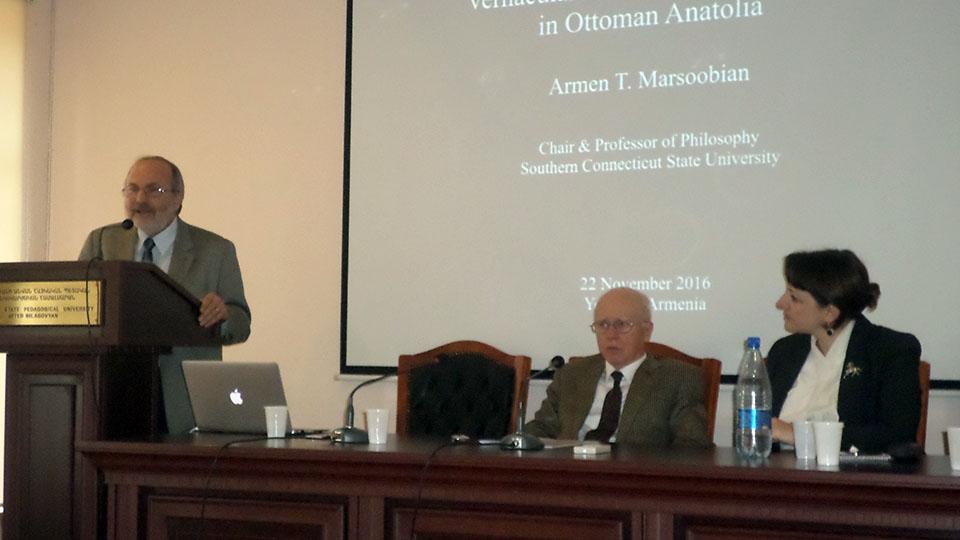
A series of lectures started at Armenian State Pedagogical University ahead of an international conference entitled “Life and Philosophy” dedicated to the 90th anniversary of renowned philosopher and academician Georg Brutian.
The lectures are held on the eve of a conference initiated by Armenian State Pedagogical University after Khachatur Abovyan in cooperation with the Armenian Philosophical Academy and International Academy of Philosophy.
The guests and participants were welcomed by ASPU Vice-Rector Srbuhi Gevorgyan who said in her speech that Academician Georg Brutian entirely devoted the last years of his life to ASPU where he was engaged in scientific activities.
The renowned academician also introduced the Yerevan School of Argumentation to the world, helping the spread of its concepts, principles and approaches.
Hasmik Hovhannisyan, Head of the Chair of Philosophy and Logic at ASPU, said the choice of the name of the conference that might seem to be common at first glance was not accidental. She stressed that Brutian’s entry to ‘global philosophy’ was marked by a monograph with the same title. “In addition to his scientific heritage, Academician Georg Brutian also ‘inherited’ us his friends and relatives, who are great philosophers and with whom he cooperated within the framework of the International Academy of Philosophy which had been founded by him. It is a great honour for us to welcome here, in this auditorium, philosophers who have great scientific merit and international reputation. Five of the visiting philosophers will be delivering lectures here,” she said.
Hasmik Hovhannisyan stressed that even after the death of the great academician they [foreign philosophers] continue to cooperate with the Chair. They members of the editorial board of Wisdom journal published by the University and have their articles regularly published in the periodical, thereby helping [others] have access to international philosophy, earn reputation and introduce themselves to the world.
The series of lectures was started by Ana Bazac, Professor of Philosophy at the Politehnica University of Bucharest (Romania), Deputy Chair of Department of Logic, Methodology and Philosophy of Science at the Committee of History, Philosophy of Science and Technology of Romanian Academy, who delivered a lecture entitled “Precautionary Principle: Its Logic and Management.”
The speaker spoke about hazards, their control and management, presented her philosophical direction, precautionary thinking, its stages and foreseeable dangers.
“Harmony is the key philosophical principle in predicting and organizing a precautionary approach. If a person perceives himself in harmony with nature, his worldview becomes clearer and he is able to understand what risks exist and how they can be made controllable.
Georgia Apostolopoulou, Professor of the Department of Philosophy, University of Ioannina (Greece) and a member of the International Academy of Philosophy, spoke on the topic “From Ancient Greek Logos to European Rationalism.”
The Professor referred to the polysemy of the term ‘logos’ and its use in ancient Greek philosophy.
Armen Marsoobian, Chair of Philosophy Department at Southern Connecticut State University and Professor of Philosophy, was the last to speak on the first day of the international lecture series.
In his lecture on the theme “Presence of Absence: Armenian Photography in Ottoman Anatolia,” the Professor stressed that the lecture [he had presented] was not philosophical in nature and mostly referred to the history of photographic art.
The speaker presented photos taken by Armenian community representatives on the territory of the Ottoman Empire, adding that photography can be viewed from two perspectives - as a piece of art and documentary material: anyway, they are inseparably linked.
Professor Armen Marsoobian noted that when ‘examining a photo people do not separate its aesthetic and documentary value. “Photos are examined because, on the one hand, they are important facts which can reflect the cultural features, traditions and customs of the given nation and community, i.e. they are subjects of anthropological analysis, they are factual material.”
The Professor also spoke about another important function of the photograph - its social value, giving details about the role of photos in Armenian families, photographic studios in Constantinople and photos of household and aesthetic value which were taken in these studios.