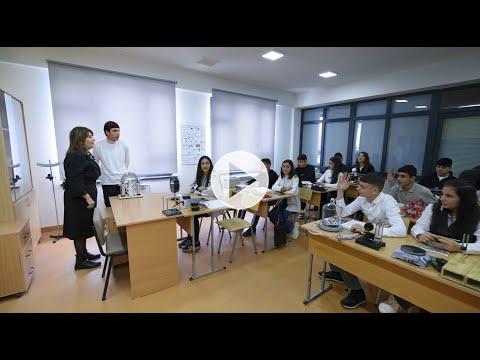
The regional conference on “Active Learning of Optics and Photonics” continues at the Pedagogical University.
.jpg)
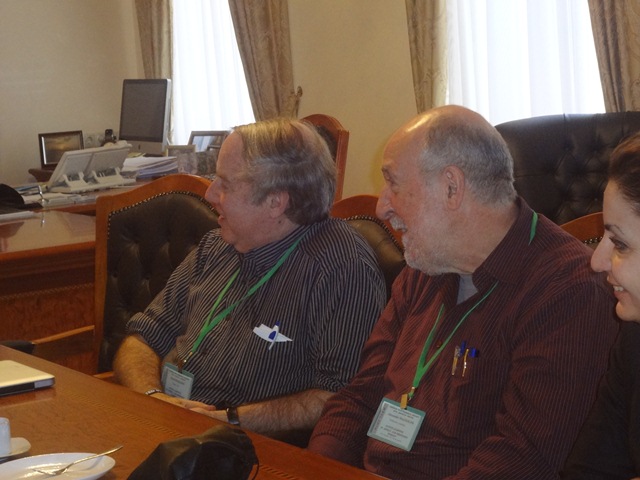
The Chancellor of the university, Doctor of Historical Sciences, professor Rouben Mirzakhanyan had a meeting with the guests of the Pedagogical University who are in Armenia to participate in and assist to the conference activities; professors David Sokolof (University of Oregon, Eugene, USA), Alexander Mazolini (Swinburne Technological University, Melbourne, Australia), and Zohra Ben Lakhdar (University of Tunisia, Tunisia) are among the guests who had great contribution to the creation and development of the project “Active Learning of Optics and Photonics”.
The foreign guests expressed their gratefulness for the organization of the conference; however they still notice that communication remains the main problem. By the way, the working language of the conference is English.
Further, the University Chancellor assured that everything was being done to overcome the language obstacle; “As a result of the University’s adopted policy, four years later our students will be able to work not only in their native language, but also in at least on foreign language. By making such undertakings more frequently, the future pedagogues will realize the necessity of language and will have to start self-educating and learning languages”.
Besides, in order to annually arrange the conference financed by the UNESCO at the Pedagogical University, the Head of the Department of Theoretical Physics and Teaching Methods of Physics, Doctor of Physical –Mathematical Sciences Edward Kokanyan submitted a programme to the UNESCO justifying the arrangement of the conference at the University.
The latter is also sure that the active learning methods introduced at the conference, will give them an opportunity to introduce the modern pedagogical technologies into; “The active learning of optics and photonics implies formation of knowledge based on direct observations of physical phenomena and allows to realize complete education with rather scarce means at poorly-equipped laboratory conditions.
The application of this method will also raise interest of high-school and university student towards optics and photonics; will improve professional orientation of pupils in the direction of natural sciences. And finally, it will give them a chanceto practically study nature”, Edward Kokanyan mentioned.