Armenian State Pedagogical University (ASPU) today hosted Terence George, an Oscar-winning Irish screenwriter and director, and Harut Sassounian, a well-known public figure,
.jpg)
philanthropist, publicist, publisher and editor of The California Courier.
They arrived in Armenia to participate in an international conference organized by the State Commission coordinating the events dedicated to the 100th anniversary of the Armenian Genocide.
ASPU Rector Rouben Mirzakhanyan said it was a great honour for him to host Terence George and Harut Sassounian at the University.
Mr Sassounian briefed the University’s professorial staff and students on the key issues of his speech at the international conference entitled “Armenian Genocide: Challenges of the Eve of the Centenary” and his observations on the issue.
Speaking about the Armenian Genocide, its recognition, compensation for damages and lost territories, the publisher of The California Courier said, “On the eve of the 100th anniversary of the Armenian Genocide [to be marked in 2015], we should not call for its recognition; we should seek justice. It is time we became claimants: a number of countries and international organizations have already recognized the Armenian Genocide.
.jpg)
We should again draw the attention of the international community to the Genocide and its recognition by organizing large-scale events.”
In order to convey our precept to the world we have to fight and demand justice. This, in its turn, implies having a general idea as the main prerequisite for restoring justice. "The Turkish government seriously follows our steps: we should tacitly plan and follow the example of Jews by transferring to future generations the idea of national claims,” he said.
Mr Sassounian also says it is very important to demand compensation for the Genocide victims and return of lost territories, bank accounts and money.
Irish screenwriter and director Terence George, who won an Oscar in 2012, spoke about his origin, the Rwanda Genocide and confessed that his visit to Armenia was of profound significance. He noted that the strength of the two peoples, cultural values and victories are determined by the fact that both nations survived genocides.
Speaking about the modern cinematographic art and the functions of media, the screenwriter said they enable to
.jpg)
disclose different phenomena and historical realities in the world. Terence George urged young people to present their own stories, using modern technologies, specifically the Internet and art.
Asked why Hollywood has not yet made a film about the Armenian Genocide, the screenwriter said, “Although a number of films with political messages have been shot in Hollywood, people there are less interested in art and politics. Hollywood is a place where one makes money: political themes and films about genocide are not considered commercial there.”
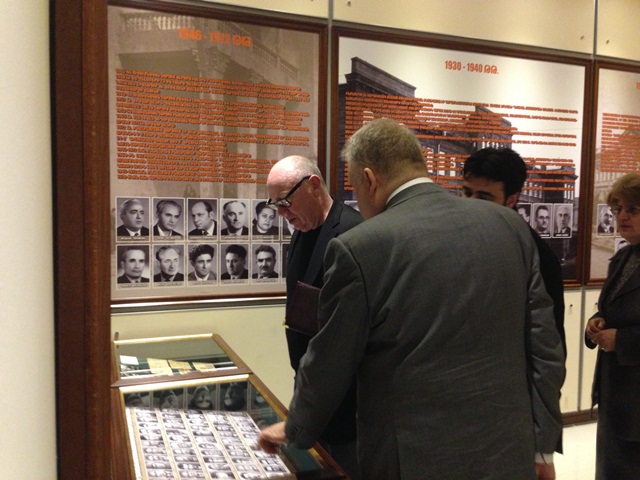
At the end of the meeting, ASPU Rector Rouben Mirzakhanyan awarded the guests with jubilee medals symbolizing the 90th anniversary of the University. The guests walked around the University building and visited its newly opened museum.
.jpg)
Terence George was born and raised in Belfast, Northern Ireland. In 1985, George made his debut as playwright of The Tunnel. In 1993, he made his debut as screenwriter and assistant director with In the Name of the Father, starring Daniel Day-Lewis, and directed and co-written by Jim Sheridan.
Much of his film work (e.g. The Boxer, Some Mother's Son, and In the Name of the Father) involves "The Troubles" in Northern Ireland.
Terence George was nominated for two Oscars: Best Writing, Screenplay Based on Material from Another Medium (1993; In the Name of the Father), and Best Writing, Original Screenplay (2004; Hotel Rwanda). On 26 February 2012, he received an Oscar in the live action short film category for The Shore.
.jpg)
.jpg)
.jpg)
.jpg)
.jpg)
.jpg)
.jpg)