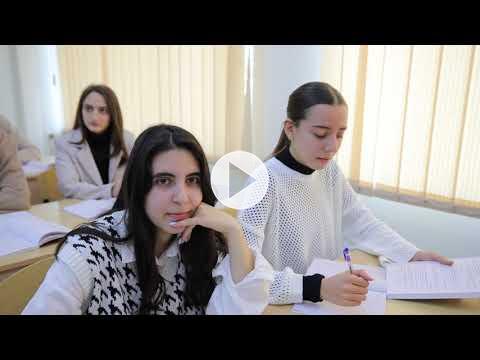
A two-day international conference entitled “The Importance of Language, Education, and Family in the Process of Repatriation” launched at Armenian State Pedagogical University
.jpg)
(ASPU) after Khachatur Abovyan on September 4.
ASPU Rector Rouben Mirzakhanyan emphasized [in his opening remarks] that the issue of migration is in the public spotlight and worries a wide circle of the society. He informed the attendees that an adaptation center has been operating at the University already for a year at the initiative of the AWO Heimatgarten Charity Foundation and ASPU and in compliance with the project Reintegration Center Armenia (RECEA). “Language courses, social and psychological support and different cultural events organized at the center help reduce the problems faced by repatriates and contribute to their social reintegration,” said the Rector.
For his turn, Armen Ashotyan, Minister of Education and Science of the Republic of Armenia, said that the numerous multifaceted and controversial issues raised during the conference are in the focus of the Ministry’s attention.
Speaking about the situation of repatriated children in Armenia, the Minister emphasized the importance of organizing their education at a proper level and meeting their educational needs, stressing their insufficient knowledge of Mother Tongue.
“The educational needs of our Diaspora formed in the course of traditional and modern periods differ greatly. Subsequently, the educational opportunities at secondary and higher education institutions also differ. The problem cannot be solved so easily. We need to create such a flexible and diverse system that will enable each repatriate to see prospects of continuing education in Armenia,” said Armen Ashotyan.
.jpg)
Gagik Yeganyan, Head of the State Migration Service of the RA Ministry of Territorial Administration, also highlighted the conference and said since 2000 the inflow of returnees to Armenia has slightly declined in the changing mosaic of migration flows. “Anyway, the issue of reintegration is of great importance after a person returns to his homeland and it can directly influence on the person’s future decision whether to stay in Armenia or leave the country. Leaving outside his homeland for several years, the person feels himself completely changed in all aspects,” he said.
Mr Yeganyan informed the presentees that the Action Plan for implementation of the Policy Concept for the state regulation of migration in Armenia in 2012-2016 envisages solutions to different problems, starting from assisting repatriates in finding jobs, recognizing their skills, qualifications and diplomas, to creating conditions for them to continue education in Armenia, deepening ties between state organizations and so on.
“The "brain drain" is not in anyone's interest in Armenia. Rather, it disrupts cooperation with the international community,” said Tina Laufer, Head of DAAD (the German Academic Exchange Service) Information Office. She added that as an educational organization, DAAD collaborates with international organizations in the fight against emigration. “We try to create a general environment that supports students’ bilateral cooperation,” she said.
Tina Laufer is convinced that the fight against illegal migration will yield results only with the support of and cooperation with other countries.
.jpg)
Virginie Artot, Director of the EU-funded project Targeted Initiative for Armenia, characterized repatriation as a long-lasting and complicated process. Relevant government agencies, international non-governmental organizations and Diaspora are the key actors in the process of implementing, monitoring and evaluating reintegration activities in a dignified, efficient and sustainable manner. “Today’s initiative has brought together a number of state and non-governmental organizations and individuals who are actively engaged in the fight against migration. Similar undertakings are aimed at contributing to repatriation and curbing its escalating scales. Language, education and family are really important on this path. Today there is a need to strengthen education and create a favourable environment for reintegration,” she added.
The conference will run through September 5.