- Հայ
- Рус
- Eng
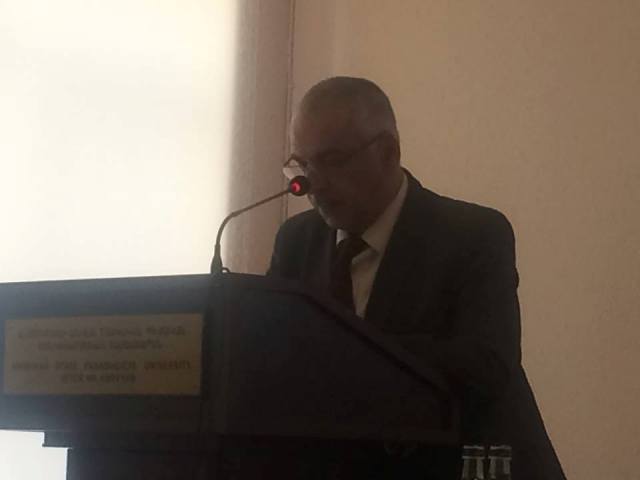
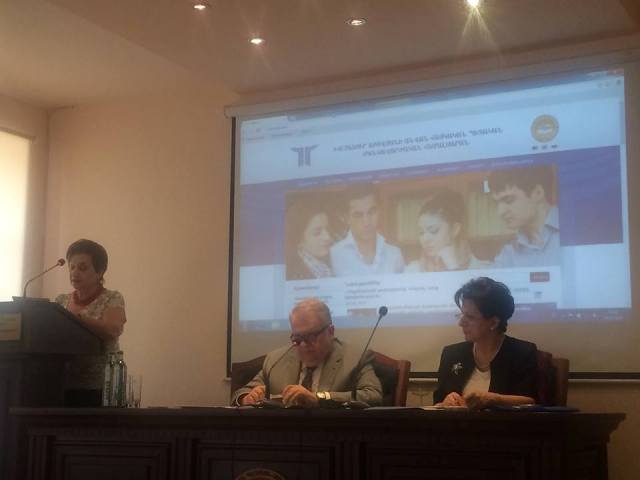
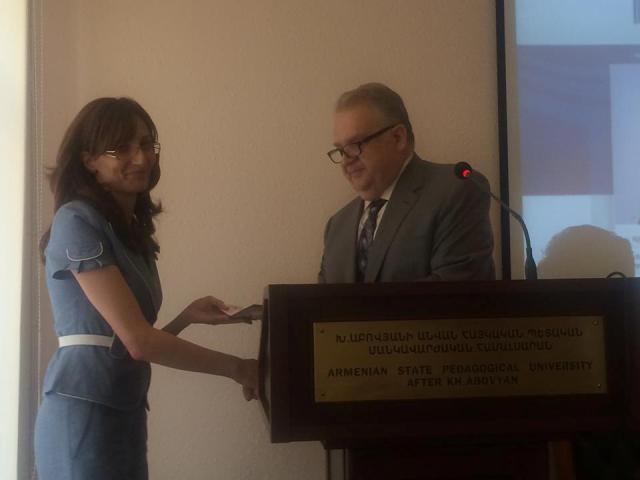
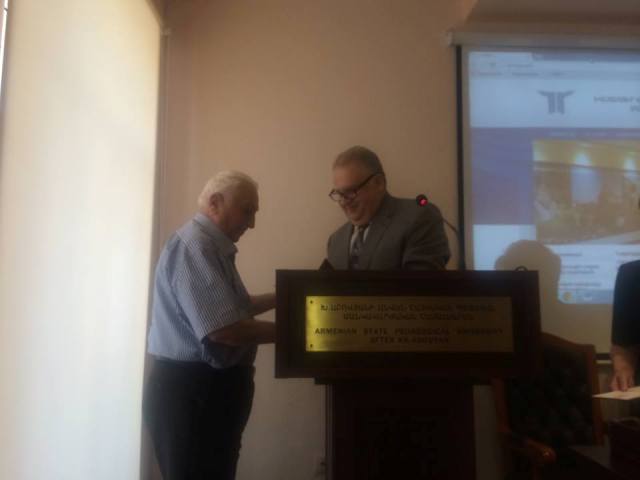
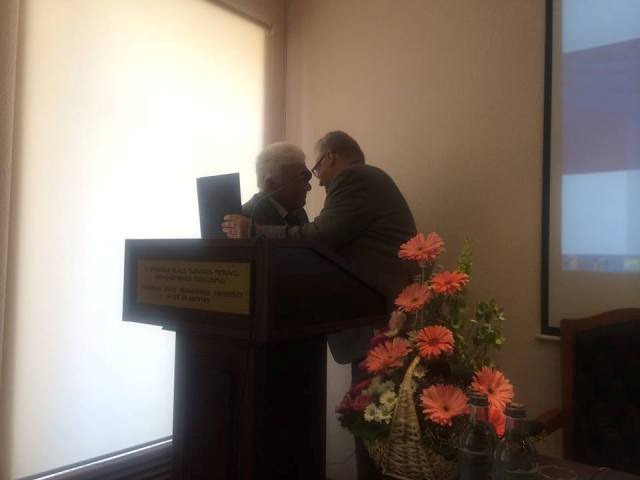
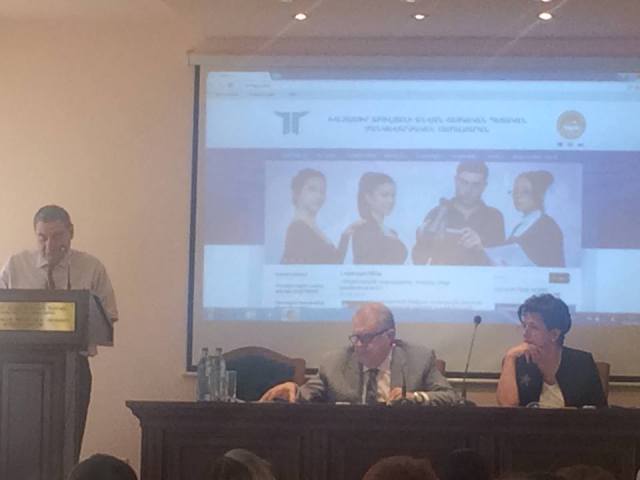
The last Academic Board seesion of the current acadmeic year was held at the Pedagogical University; the University’s Rector Rouben Mirzakhanyan made his already habitual congratualtions to those who had their anniversaries in that month, after which he granted academic titles to six Professors and eleven Associate Professors.
Following, the Head of the Educational and Methodology Department, Vice –Rector Mher Meliq-Bakhshyan reported about the counting standards of educational activities as the first issue on the agenda of the Academic Board.
The latter noticed in his speech that the transition of the curricula, assessment and the new pedagogical practice system required the review of the counting criteria of the educational workload; besides, the lecturers’ workload was also reviewed.
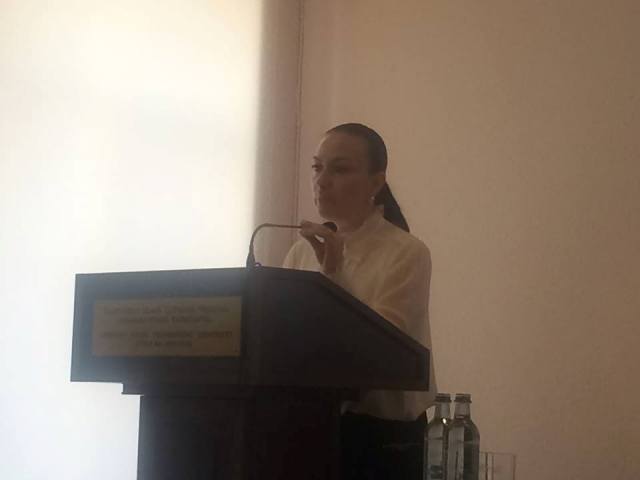
“In he past, professional lectures constituted more than 50% of the (theoretical) classes at a Department, the remaining Departments the workload of which mainly consisted of practical seminars, laboratory and individual classes, which were estimated in another scale”, mentioned the Vice –Rector, suggesting to calculate the workload of all the Departments with one common scale, also adding the hours of checking written assignments and reviewing graduate thesis.
Next, the Vice-Rector for the ASPU Education Quality and Distant Learning Tigran Ayvazyan and the Head of the Educational and Methodology Department, Vice –Rector Mher Meliq-Bakhshyan reported on the final attestation examination results.
The Vice-Rectors summarized the President’s report and observations and introduced the positive sides of final attestation examinations and its drawbacks, drawing parallels with the previous years.
“Graduate works were mainly outstanding with their modern and to the certain extent unique nature; the students received greater assistance by using the information literature available in the examination rooms; as a result of expanding relations with scientific research institutes the graduate thesis were mostly of scientific nature, the graduates have highly professional skills; nevertheless, there was some deficiency when replying to the questions in the field of pedagogy and methodology.”
Additionally the Vice-Rectors noted that the graduate works and thesis have structural shortages and that the feedback provided by the supervisors and reviewer of graduate works and thesis are often a formality; the students’ individual and analytical skills are shown dim and weakly; a vast number of students demonstrate a low level of oral and written speech.
Further on, suggestions were made at the Academic Board particularly to mention the positive and negative sides equally when writing reports to the Committee President, to discuss the mentioned suggestions and remarks during the Faculty meetings and Department sessions, to consider the selection of supervisors and opponents of graduate thesis, encourage students to use more technical instruments; the decisions on the abovementioned was accepted unanimously.
Afterwards, the Presidents of the Standing Committees at the Academic Board Ms. Srbouhi Gevorgyan, Aelita Doloukhanyan, Mejlum Yeritsyan also presented their report on 2013-2014 academic year, introducing the activities implemented by the Committee.
Next in turn, the Head of the Education Reforms and Quality Assurance Department Mkrtich Avagyan reported to the Board members about the installation of the students’ knowledge checking and assessment system at the University.
“Educational programmes for three criteria – students, teaching staff and professional teams, realizing an external evaluation of self-analysis, educational and quality assurance processes were implemented at the Pedagogical University by the group of specialists from the National Centre for Professional Education Quality Assurance Foundation. As a result, the ASPU studnets’ assessment system is in need of serious review; it does not have the formats and indexes that correspond to teaching and learning methods, due to which it could be possible to acquire the skills in compliance with the anticipated learning results.”
Furthermore, Mkrtich Avagyan reminded that still in 2012, the Pedagogical University’s Academic Board had discussed and expressed favourable positioning towards the new system of checking and assessment of students’ knowledge at the ASPU, according to which assessment was based on the outcomes of the subject and the compliance of professional education, its aims and objectives, and its competences.
“It is suggested to use a mid-term knowledge assessment system for the undergraduate and graduate students that will be based on credits received in taught subjects during the term in forms of current students, intermediate qualitative and cumulative total checks; the final scoring will base on the cumulative total of points received.”
What is more, the Head of the Education Reform and Quality Assurance Department thoroughly introduced the results of queries of a certain focus groups about the new assessment system installed at the Faculties of Primary and Special Education, the indicators of being informed thereof, the strengths and weaknesses of the system, the suggestion of lectures, Deans and students.
In his turn, the University’s Rector Rouben Mirzakhanyan highlighted the introduction of the new assessment system assuring that the system has a number of advantages, and that the only disadvantage is its innovative nature.
In this issue, the Academic Board made a unanimous decision on introducing the new system of students’ knowledge checking and assessment at all first-year courses in all Faculties of the ASPU starting from 2014-2015 academic year.
Several current issues were discussed in the report of the Vice-Rector for Personnel and International Cooperation Ara Yeremyan and submitted to the Board’s approval the Statute of the University Library, History Museum, Psychology and Research Laboratories, the Academic Centre “Spyurq”/”Diaspora”, Laboratory of Quantum Electronics and Integrated Optics.
In the result of the report of the Head of the Educational and Methodology Department Mher Meliq-Bakhshyan the Academic Council approved the question of renaming the University’s Department of Economy and its Teaching Methods changing it into Economy and Management.
Later on, the Head of the Department of Foreign languages Melanya Astvatsatryan presented a number of suggestions and amendments and supplements based thereon in the “Concept Paper on Pedagogical Education Development” submitted by the working group organized from a number of Departments and Faculties.
And last but not least, during the Academic Board session a secret ballot was arranged as a result of which vacant positions in the teaching staff of were replenished with the following candidates- Levon Abajyan was elected at the Department of Mathematical Analysis and Theory of Functions, and Valdimir Petrisyan and Vanik Virabyan were elected as professors at the Department of History of Armenia.
Four candidates nominated for academic titles received the titles of professors, and three of Associate Professors.
At the end of the session the Vice-Rector for Academic Affairs Srbouhi Gevorgyan submitted to the Academic Board’s approval the PhD dissertations and manuals to be printed.