- Հայ
- Рус
- Eng
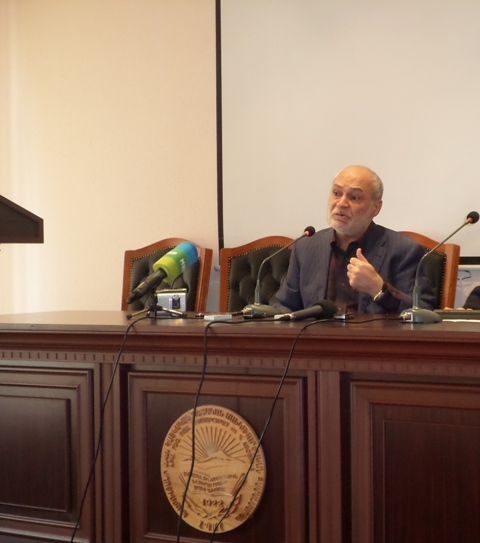
“If once books wrote about the “forgotten and neglected” genocide, today they are writing about its recognition and condemnation by different countries. The events marking the centennial of the Armenian Genocide marked a turning point in the history of Armenia and the world in general,” Andranik Mihranyan, Head of the New York office of the Institute for Democracy and Cooperation, Honorary Doctor of Armenian State Pedagogical University (ASPU), said during an open lecture at ASPU.
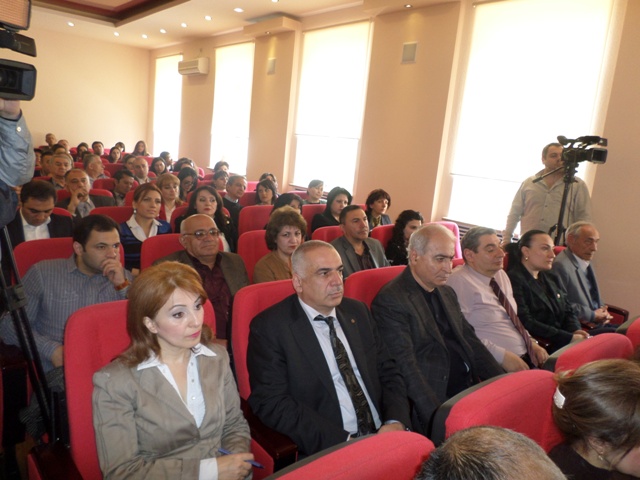
The political analyst, who is in Armenia for several days, today visited ASPU to meet the University’s teaching staff and students. Speaking about the current political developments Mr Mihranyan particularly dwelt on the reaction of Armenians and the international community to the centennial commemoration of the Armenian Genocide, including the ensuing events on the international level.
Andranik Mihranyan stressed that the events taking place in Armenia and Turkey [on April 24] were in the center of attention of international media, with the Armenian side having an obvious advantage.
He also spoke about the role and participation of Russia and the USA, which have the largest Armenian communities, in the process of recognition of the Armenian Genocide. Comparing these two countries, Mr Mihranyan noted with regret that ‘the Armenian community in the United States has again been unable to do anything.’
At the same time, the political analyst said he does not share the opinion that America does not want to strain its relations with Turkey [therefore it does not recognize the Armenian Genocide]: Russia is closely connected to the same country [Turkey] but Russia organized various events at the highest level of the government to commemorate the innocent victims of the Armenian Genocide.
“The numerous commemorative events and the attention of the world eliminated the need for establishing a joint commission of historians and experts [from both Turkey and Armenia] to study the events of 1915,” the political analyst said, adding, “We do not forget kindness and we do not forgive evil. Armenians have historical memory.”
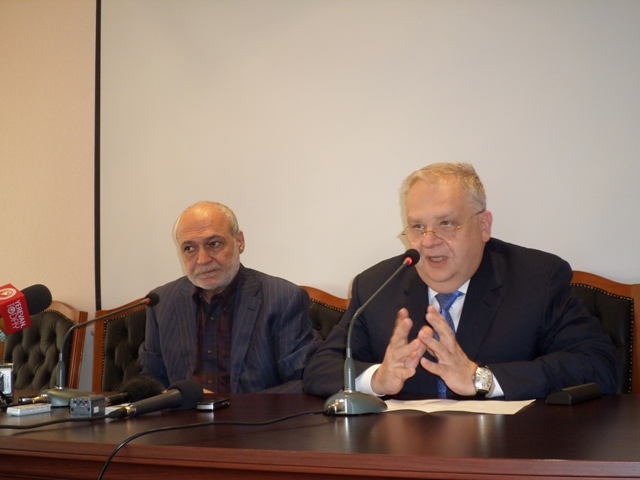
One hundred years after the mass killing of Armenians by Ottoman troops, Mr Mihranyan says changes are observed in the attitude of Turkish society. However, despite the fact that people in Turkey are changing their attitude to the historical reality, Turkish authorities still cling to their policy of denial.
During the meeting, the political analyst also answered numerous questions concerning the international recognition of the Armenian Genocide. The attendees wondered what expectations Armenia can have from the resolution on the Armenian Genocide adopted by the German Bundestag and the resolution on Armenian Genocide Centennial adopted by the Euronest Parliamentary Assembly and what can the recognition of the Armenian Genocide by the United States mean for Armenians.
“Waiting for the US to recognize the Armenian Genocide is a waste of time, resources and energy, especially considering the fact that it will not change anything as long as we do not have a judicial decision,” Mr Mihranyan said adding. “Nor does the recognition of the Genocide by Germany make radical changes at this moment. It is important to raise the issue at the global level.”
Speaking about his dreams, the political analyst expressed hope that Turkey will overcome the ‘fear of compensation,’ recognize the Genocide, repent and apologize to Armenians. “I shall be glad if Turkey returns us Ararat and Ani, I shall be glad to see monuments built in places where massacres were committed,” he said.
It is due to mention that Mr Mihranyan’s parents were deported from Western Armenia in 1915.
At the end of the meeting, ASPU Rector Ruben Mirzakhanyan thanked the politician analyst for the visit and lecture and expressed hope that such meetings would be held more frequently in the future.