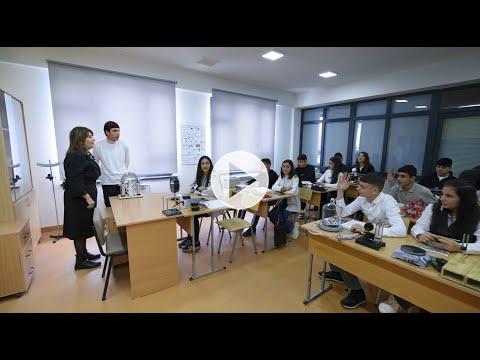
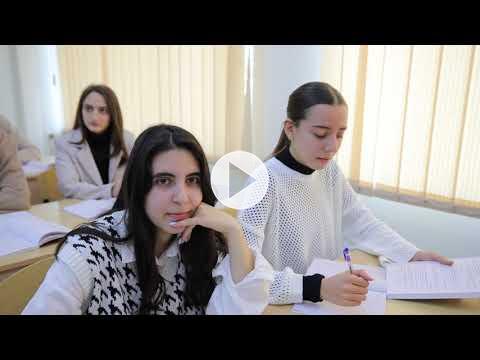
This year, five 1st year MA students with the specialization of astronomy from the Department of Physics, Faculty of Mathematics, Physics and Informatics spent their summer
.jpg)
internship at the Byurakan Observatory after Victor Hambardzumyan.
The internship was supervised by the Candidate of Physical –Mathematical Sciences, Associate Professor Sergey Nersisyan, and the Candidate of Physical-Mathematical Sciences Smbat Balayan.
Under the latter’s supervision, starlit sky observations were organized with the 50cm mirror diameters Cassegrain telescope. Among the celestial objects, particular attention was given to the planet Saturn, the Moon, open and spherical star heaps, as well as to the Ring Nebula in the Lyra constellation, the double stars, to the Andromeda Galaxy, and other celestial objects.
In addition, Smbat Balayan also told the students about the ongoing modernization and automation of the 1m diameters Schmidt telescope.
In his turn, the Academician Eduard Khachikyan made a detailed introduction to the students about the research activities conducted at the observatory, also about the investigations of the “Galaxies” groups supervised by him, as well as told about the enormous spectrum observations of the Margaryan galaxies with ultraviolet excess and the interesting results achieved.
Moreover, thematic lectures, observations, meetings, as well as a visit to Victor Hambardzumyan’s house-museum were organized during the internship.
.jpg)
“After the oral lectures received at the University, the direct observations assisted in correct understanding and clearly realization of the practical usage of the knowledge obtained. Besides, it gave an opportunity to continue the postgraduate thesis’ research work in a more scientifically literal and better-grounded way,” the first year MA student from the Department of Physics of Faculty of Mathematics, Physics and Informatics said.
Parallel to the research work, the students organized their leisure time with conversations around the fire at night, intellectual games, songs and music.
It is important to mention, that the Observatory is equipped with six telescopes, the biggest of which has a 2.6 m mirror diameter, and the next one in turn is the 1-meter Schmidt telescope, which is on its modernization phase. The others have comparatively smaller diameters – 60, 50, and 40 cm.