On 20-24 September, Associate Professor of the Chair of General Physics on the Faculty of Mathematics, Physics and Informatics Sergey Nersisyan and 2nd year Physics MA student
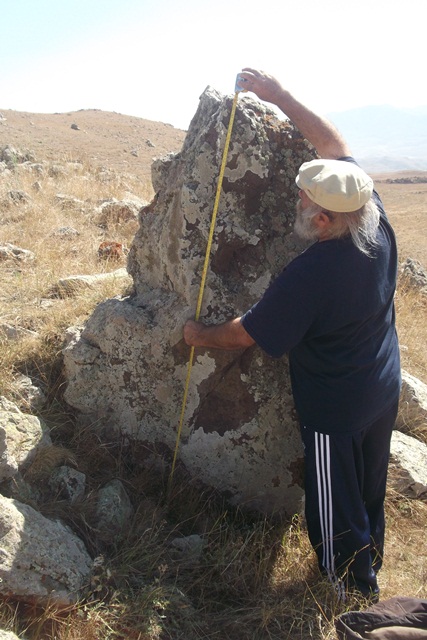
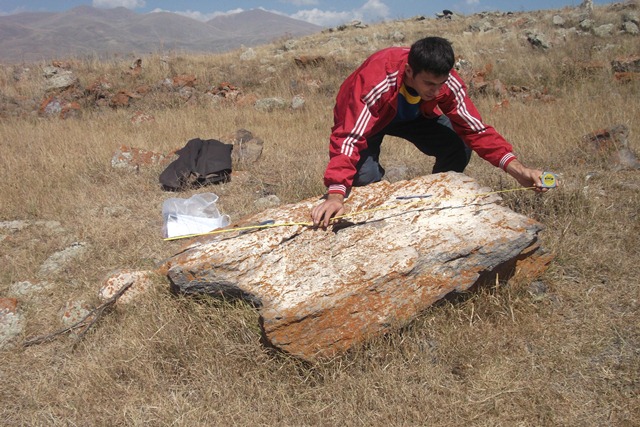
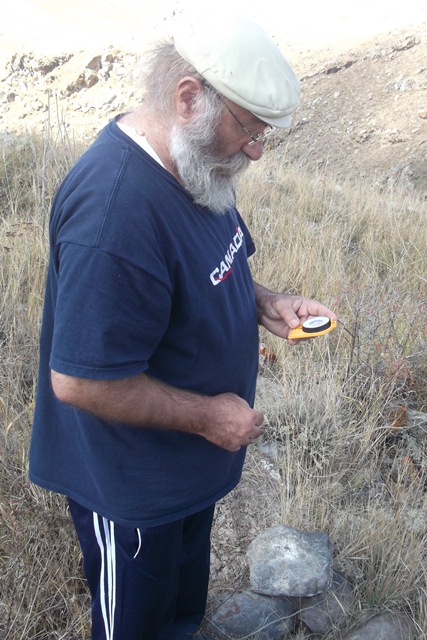
Sanasar Khalatyan realized research activities of astronomical nature and of the local buildings.
23 September, on the day of the autumn equinox, the sunrise was observed and it was found out that the Sun disk can be seen on the rising point from the hole on stone number 79.
The whole process of the sunrise, observable from the stone holes, was photographed. In fact, it is quite possible that the local people determine on the start of fall and the coming year with this method, and this, in its turn, confirms the hypothesis that the Qarahounj is an observatory.
“The local habitats, as well as the separate stones installments and the determination of the Sun and the Moon were measured and photographed. A huge amount of material was collected which will be further drafted; however, some primary conclusions have already been made,” Sergey Nersisyan mentioned.
Besides, the latter is assured that by comparing the above mentioned data with that generated by other archeologists, historians, ethnographers and astronomers, comprehensive and general conclusions might be achieved.