- Հայ
- Рус
- Eng
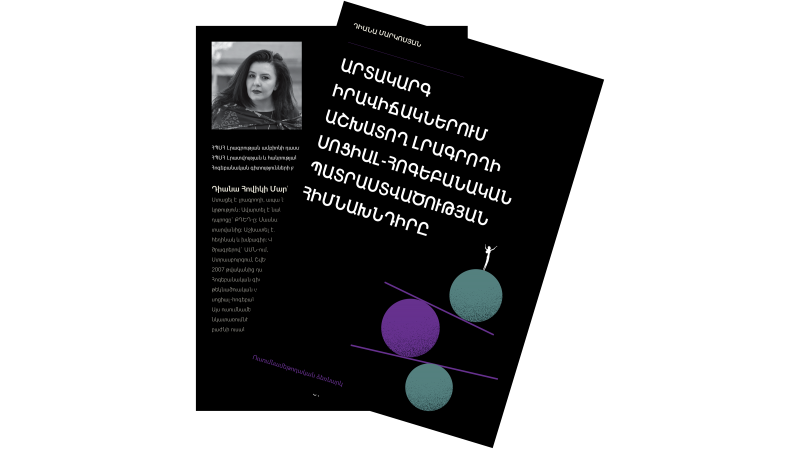
“Socio-Psychological Preparation of Journalists Covering Emergencies” – a book by Diana Markosyan, Candidate of Psychological Sciences, Lecturer at the Chair of Journalism of Armenian State Pedagogical University and Head of the Media and Public Relations Department in the same university, has been published.
It is intended for higher education institutions (HEIs), specifically students studying journalism, and working journalists/reporters.
“The media play a key role in social governance, especially in emergencies. Thanks to the media, any emergency or natural disaster receives information and communication resonance, which can either deepen the catastrophic consequences or help avoid depression and apathy. In other words, today the media are a kind of psychotherapy in society, especially now that coverage of emergencies and emergency response prevails over coverage of other events thus creating an effect of adapting collective consciousness to disasters and their inevitability. As a result, people do not have adequate perception of safe behavior in emergency situations," Diana Markosyan said in a conversation with old.aspu.am.
The author of the book says given the absence of a balanced relationship between the real level of the emergency situation and the nature of its coverage, people are subject to double psychological stress and pressure – on the one hand, they are under the influence of the given situation, on the other hand, the coverage of the situation in the media. “Being a social regulator of society, the media do not contribute to the social and psychological stability of society in emergency situations and fail to fulfill one of their primary tasks – help psychological correction of collective consciousness,” she stressed.
Diana Markosyan notes that one of the reasons for this problem is inadequate psychological training and preparation of journalists, which equally, or in the first place affects the journalist and then, through the journalist, the audience.
In this context, the author stresses the importance of psychological preparation of journalists and presents her reasoning through a scientific experiment, which was carried out also among journalists working in extreme conditions and covering emergency situations in Armenia and Artsakh.
The manual can also serve as a guide [for journalists] to respond effectively to health and safety incidents and other emergencies, gives them tips on carrying out their work under safe condition in emergencies and war situations.
The educational-methodical manual gives the description of the course on "Socio-Psychological Preparation of Journalists Covering Emergencies" in accordance with the academic standards and requirements for the Bachelor's degree in journalism. Also, methodological materials are presented in the book.
The work reviewers are Professor Srbuhi Gevorgyan, Rector Armenian State Pedagogical University, and Professor Kamo Vardanyan, Head of the ASPU Research Centre.
"In the geopolitical environment we live in, emergencies, natural disasters and wars are inevitable. Whether they want it or not, people are affected by the mass media and are not enough resistant to stress. Therefore, adequate psychological preparation of journalists is of great importance," Diana Markosyan said in conclusion.